
Whatcom Previous-Resident Source Eras
The backward trail starts with the era in question. Current Whatcom County property data identifies a parcel and title-owner line, while recorded instruments carry ownership through time. Directories and census schedules can name occupants who never held title. Maps, permits, and newspapers then explain changes to the building or household. Each source answers a narrower question than the phrase “who lived here before.”
| Source | Years it covers | Where held | What it can show |
|---|---|---|---|
| Auditor deeds and instruments | Microfilm to 1853; digital images to August 1991 | Whatcom County Auditor | Grantors, grantees, dates, and legal descriptions |
| State Archives land index | October 2017 to present | Washington Digital Archives | Indexed names, years, and document types |
| Polk directories | 1890 and 1899 to present | Bellingham Public Library | Names, spouses, occupations, and addresses |
| Address cross-index | 1931 to present within the Polk holdings | Bellingham Public Library | Householders found from a street address |
| Whatcom census collections | 1870 and 1871 | Washington State Archives | Named people and household context |
| Sanborn maps | 1904 public set; other catalog years vary | Library of Congress and State Library | Block, footprint, material, and use |
| Probate images | 1853 to 1929 statewide county collection | FamilySearch | Estate files that may close a resident trail |
Start with the newest source that overlaps the target date. Move backward only after noting the exact identifier, whether it is a parcel Geo ID, instrument number, directory year, map sheet, or probate file. This prevents two similar names from being merged.
Reverse the Whatcom County Deed Chain
The Whatcom County Property Search is the current anchor. Search by street number and partial street name, then record the property ID, 16-digit Geo ID, title-owner line, situs address, and legal description. A situs address is the physical parcel location. It may differ from the taxpayer mailing line and does not prove that the owner lives there.
- Identify the present parcel and legal description in the assessor record. Preserve the appraisal year and displayed update date.
- Open the Digital Research Room, accept its notice, and locate the current owner's acquisition deed.
- Copy the instrument number, recording date, document type, grantor, grantee, legal description, parcel reference, and any prior instrument number.
- Search the seller as a grantee to find that person's earlier acquisition. Compare legal descriptions and watch for parcel splits.
- Repeat until the online material ends, then ask the Auditor for microfilm or an assisted historical search.
The chain should include deeds of trust, releases, easements, liens, boundary-line agreements, plats, and trustee sales when they affect the parcel story. An assessor card is a tax snapshot, not a certified title opinion.
- Grantor
- The party transferring an interest in the recorded instrument.
- Grantee
- The party receiving the interest.
- Chain of title
- The linked sequence of recorded transfers for the same land.
- Legal description
- The lot, block, survey, or metes-and-bounds wording that identifies land more reliably than an old street number.
Whatcom Deeds Beyond the Screen
Online access is only one channel. Whatcom County says digitized images reach August 1991 and microfilm reaches 1853. The State Archives land collection has a different span, October 2017 to the present, and warns that the current year may be incomplete. Those ranges describe interfaces and collections, not the full age of County custody.
The Auditor copy service accepts requests with party names, an approximate date, document type, or file number. Mail requests should include a return address and self-addressed stamped envelope. Regular copies are $1 per page. Certified copies cost $3 for the first page and $1 for each added page. Assisted pre-1980 research is $8 per hour. The office is at 311 Grand Avenue, Suite 103, Bellingham, and can be reached at 360-778-5100 or recording@co.whatcom.wa.us.
The Whatcom County Digital Research Room is the first online view of indexed documents and images.
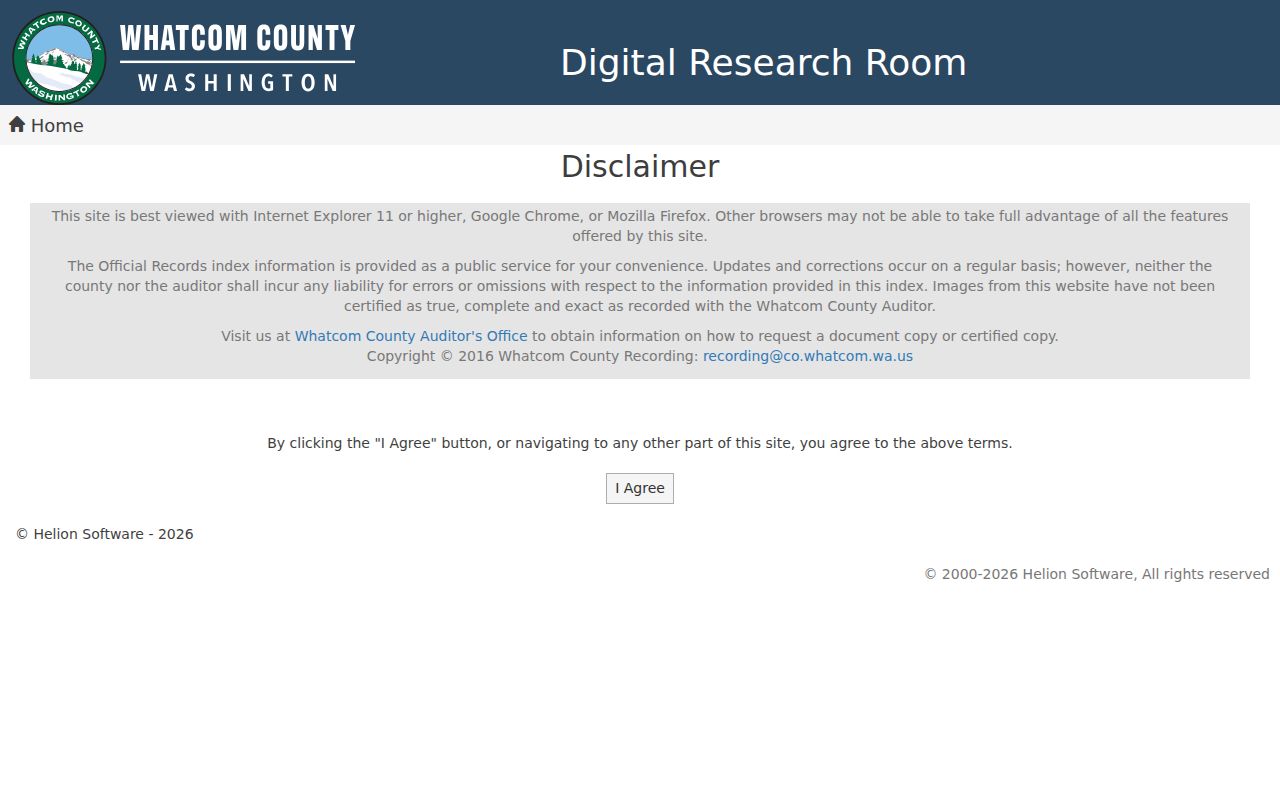
The disclaimer screen marks the difference between convenient online research and an official certified copy from the Auditor.
The Washington State Archives land-record portal supplies a second indexed route for recent instruments.
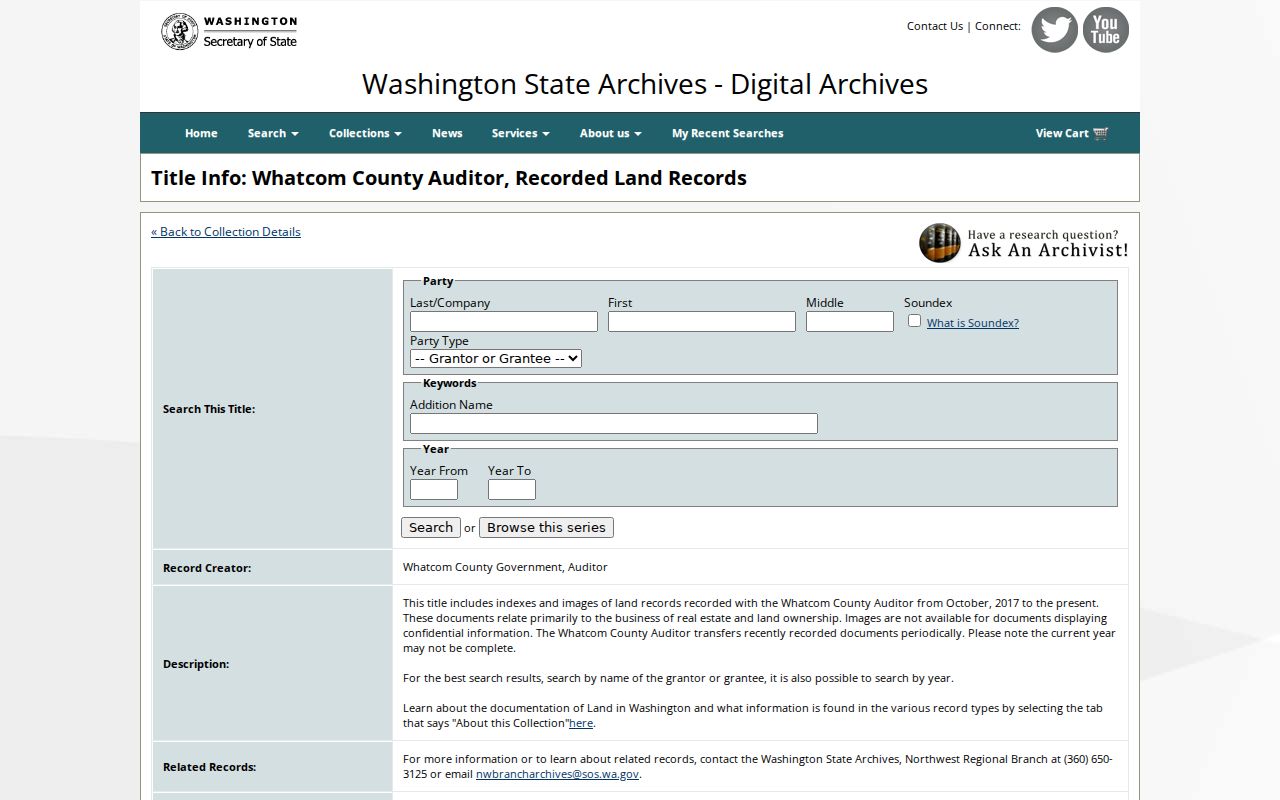
The archive capture shows another access point for previous residents research. Its stated span must stay separate from the Auditor's older microfilm and image holdings.
Note: An index row or online image is not a certified copy; request certification from the Whatcom County Auditor when the official form matters.
Historic Names Hide Past Residents
The most useful Whatcom County comparison is old place wording against the modern map. The local house-history guide identifies Bellingham, Fairhaven, Sehome, and Whatcom before 1890. New Whatcom and Fairhaven shared boundaries from 1890 through 1901, and Consolidation Avenue separated Whatcom and Fairhaven before 1904. A person may be indexed under one town while the present parcel is described as Bellingham.
Search all relevant labels before deciding that previous residents are missing. Copy the original street phrase without silently replacing it. Then compare the route with a directory address index, Sanborn block, incorporation map, and deed description. This local four-name trap is more important than a loose modern text match.
Pair Whatcom Directories and Census
Ownership is only half of an address history. Bellingham Public Library's Polk holdings can name a resident, spouse, occupation, and address. The address cross-index begins in 1931. Earlier editions may use route phrases, including street segments rather than a modern number. The complete shelf and entry notation are covered on the Whatcom County city directory page.
Use a short, repeatable flow for the household layer:
- Choose a directory edition within the deed owner's time window and copy the address entry exactly.
- Find the same name in the alphabetical section, preserving initials, spouse, occupation, and town label.
- Compare the prior and next available directory years to bracket arrival or departure.
- Search the 1870 or 1871 State Archives collection, a later federal census, or a territorial substitute that fits the date.
- Test the household against a newspaper, probate file, cemetery record, or delayed birth record before merging identities.
The 1890 federal census gap is a real local obstacle. Useful substitutes named by the Library include the 1885, 1887, and 1889 territorial materials, directories, deeds, newspapers, probate, cemetery records, and delayed births. HeritageQuest is available remotely with a library card. Ancestry Library Edition is in-library.
See the Whatcom Address Change
Sanborn maps answer questions a directory cannot. The free 1904 Library of Congress set contains 83 sheets for Bellingham, Fairhaven, and Sehome. A sheet can show the block, building footprint, materials, openings, fire walls, and use labels. It can help determine whether a house number changed, a structure was replaced, or two printed addresses refer to the same block.
Pair the map year with the closest directory year. Then compare the building against deeds and permits rather than treating map detail as title proof. Washington State Library microfilm extends the map route, but the exact Bellingham sheet availability for other years must be checked in the catalog. This is a strong way to separate a change in the person from a change in the structure.
Close a Whatcom Resident Trail
A person who leaves a directory may have moved, died, gone unlisted, or been missed by the compiler. Bellingham Public Library offers several newspaper channels instead of one complete obituary index. A print Herald index covers January 1988 through June 30, 1992. The Bellingham Herald Index runs from July 1, 1992 through December 31, 2005. Full text begins in September 1999 and includes some obituaries. Microfilm is the fallback for other years.
Probate can explain the transfer of an interest after death. The Washington county probate image collection spans 1853 through 1929 and includes Whatcom material, with access through FamilySearch. For a later estate, route the inquiry to the proper Whatcom County court index and Clerk. A probate file may identify heirs or property, but the source must be checked rather than inferred from a surname.
Naturalization follows a separate custody chain. Before September 27, 1906, several kinds of courts could naturalize. Later federal records may be at NARA, while older local records can remain with courts, archives, or historical groups. The NARA naturalization guidance and NARA Seattle are appropriate fallbacks when the local trail points to citizenship records.
Note: A missing directory row is a question to test with another source, not proof that a household had left Whatcom County.
Fee Books Bridge Whatcom Gaps
Historic Auditor fee books are an unusual bridge when a deed image or modern index result is absent. County annual-report research says these books can preserve recording date, submitter, Auditor file number, grantor, grantee, volume and page, payment amount, and notes. That set of fields may point from a sparse name entry to the correct recorded volume.
Whatcom County's record imaging has changed in stages. A 2017 report described a 1.2-million-image addition for material from 1959 through 1988. The 2021 report described scanning 357,883 pages at the Northwest Regional Archives and importing 20,950 images from 1974. More than 90,000 historical records were added to the Digital Research Room in 2025. Search dates and interface names should therefore stay in the log. A negative result may reflect an index phase rather than an absent document.
After documenting previous residents and the present title, the Auditor's free Property Recording Alert Service can monitor a known name or 16-digit assessor parcel number for a newly recorded document.
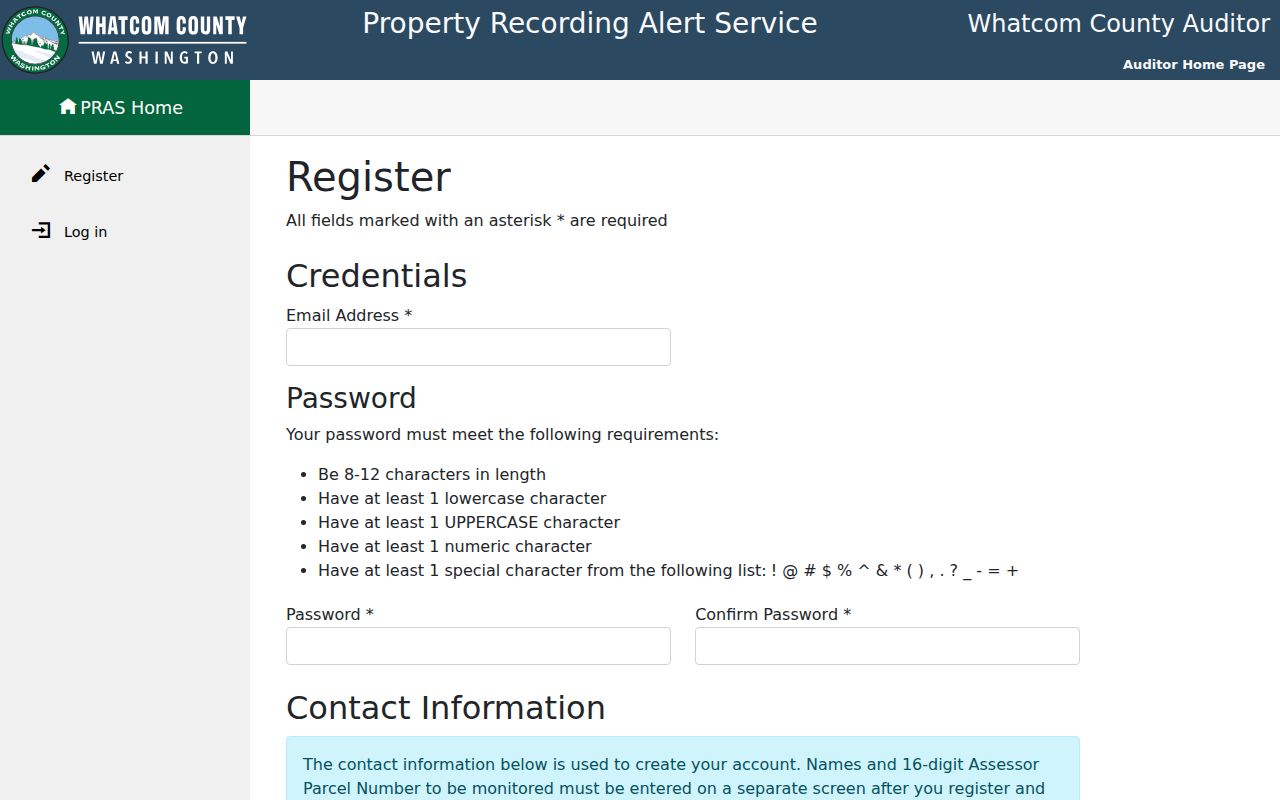
The registration screen starts a future alert, not a historical search. Each notice is informational and should lead back to the Auditor's recorded document before it is added to the address timeline.
Use Previous Residents Records Carefully
Previous-resident research is suitable for family history, a building history, estate work, and personal curiosity. It should not be used to track, expose, or harass a living person. The Washington Address Confidentiality Program can replace a participant's physical address with a substitute address in public-facing workflows. Never try to reverse that substitute through parcel, deed, voter, court, or newspaper links.
A directory entry supports a printed name at a place and time. A deed supports a recorded transfer. A census reflects its own enumeration, and an obituary is a published account. None should silently be converted into a claim of present residence. Keep uncertain matches separate, especially where initials, common names, changed street labels, or parcel splits appear.
Lawful personal use. Stop the search if an Address Confidentiality Program indicator or protected address appears, and contact the custodian about the correct confidentiality process.
For a present-day parcel and full named-street chain, the Whatcom County streets page explains the current address route. The past-resident trail should remain date-bound.